Watching CNBC’s Empty Office Space Changed How I See the Conversion Feasibility
What a documentary reveals about the true barriers to transforming vacant office space into affordable housing
For the past year, my community has seen an influx in local politics as a result of newly-proposed low-income housing in our traditional suburban neighborhood. As a California resident, my area's situation is a result of a larger problem being solved with Band-Aid solutions- the housing crisis.
At first, I thought to look to already exesting infrastructure in my research. With over 1 billion square feet of vacant office space due to Covid shifts, the transformation of these buildings into dwelling units came across as a practicle solution- a "two birds with one stone" answer.
And this idea isn't just shared by me, it's a sentiment well-echoed through the urban planning community. After discussing with Shane Phillips, UCLA Planning Researcher, and my county's planning board, they all agreed that conversions were a sustainable solution. However, another shared sentiment was that the issue was beyond their reach, more of a "Big government policy, not in our control" as I remember a councilwoman told me.
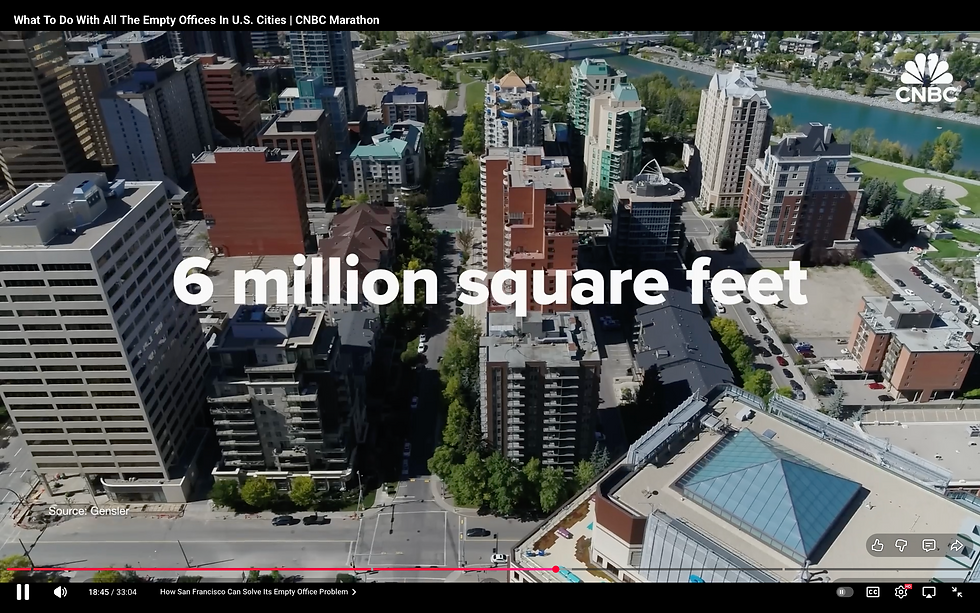
After watching CNBC's 'What To Do With All the Empty Offices in U.S. Cities, it became painfully clear that this was purposeful- a zoning stunt that lacks incentive for developers to create long-term affordable housing.
Most of these towers sit in "commercial only"districts, unable to move from their coorperate fate written in laws made decades ago. In order to transform the space, developers have to hop through a plethora of hoops of enviornmental hearings, legal documents, and coorporate pushback. And while this process drags on, policticians use buzzbords like "affordable housing" to gain public likeability. Towns like mine, never designed to provide for such a high density population, are now the subject of said "affordable housing" campaigns, proving a true lack of willingness to change simple policies to save square footage.
The documentary reiterates that while legal hurdles pose a large weight on the conversion process, the other half is developer incentive (or lack therof!). These transformations aren't light work-- plumbing lines, kitchens, and lighting plans have to be completely redone. A challenge like this is near impossible without proper reimbersement, which is why many of the structures are turned into luxury housing (completely missing the point here!). Tax credits, grants, rebates...it's not hard for the government to switch to sustainable solutions instead of invading new land.
That is what is the most frustrating. We have a society where cities desperately need housing, where downtown office spaces are hollowing out, where people like my neighbors panic at the idea of density...but the people with the power to change zoning maps and offer real incentives simply don’t. Not because they’re unaware, but because prioritizing affordable housing has never been politically convenient.


Comments